
Hiring Thai Employees: Payroll, Compliance, and Employment Rules

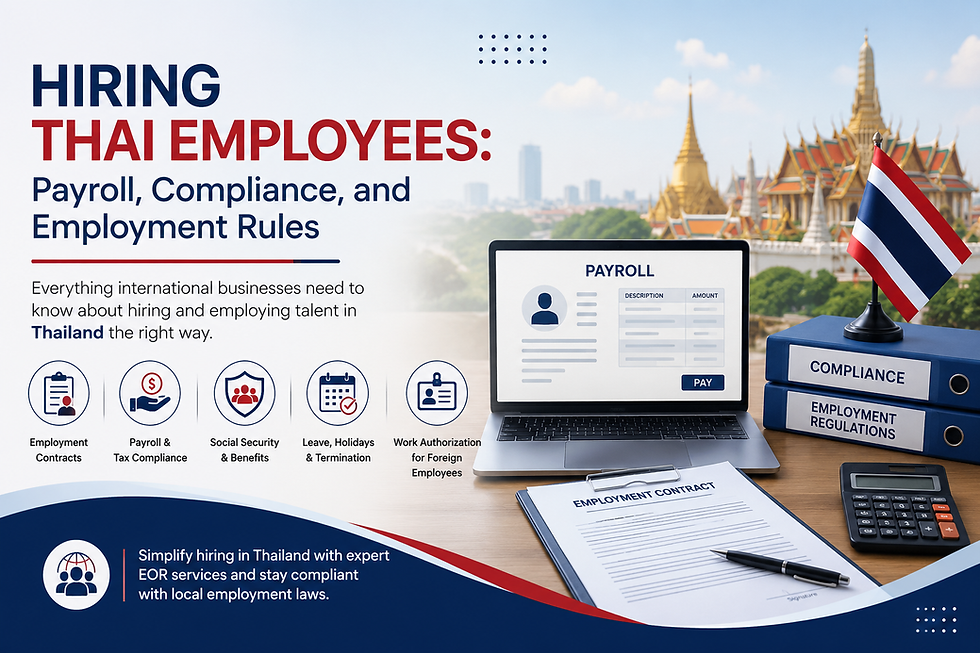
International businesses wishing to build a presence in Southeast Asia may find it appealing to hire workers in Thailand. But hiring employees entails more than just identifying qualified applicants. Employment contracts, payroll, income tax, social security, work licenses, and other local regulations must also be taken into account by businesses.
For companies that do not have their own Thai entity, EOR services can provide an alternative approach to establishing a local employment structure. An Employer of Record can employ workers on behalf of a foreign company while handling designated employment and payroll responsibilities in accordance with local requirements.
What Should Businesses Know Before Hiring in Thailand?
Thailand has its own system for social security, payroll, and employment. Before making employment offers to Thai workers, foreign employers should be aware of these criteria.
Key areas include:
Employment contracts
Working conditions
Employee compensation
Personal income tax
Social security contributions
Payroll administration
Leave and holidays
Termination requirements
Work authorization for foreign employees
The exact obligations can depend on the employee's role, nationality, working arrangement, and the structure of the hiring company.
What Is an Employer of Record?
An Employer of Record, or EOR for short, is a third-party organization that takes on the official role of an employee's employer while the client company handles the employee's daily tasks.
The EOR may handle responsibilities such as:
Employment contracts
Payroll processing
Tax withholding
Social security administration
Employee onboarding
Statutory benefits
Employment documentation
In most cases, the client company is still in charge of the worker's tasks, responsibilities, output, and business goals.
An international business that wishes to hire workers in Thailand without first setting up a local employing corporation may find this arrangement helpful.
How EOR Services Work in Thailand
The process can be relatively straightforward, although the specific arrangements vary between providers.
1. Identify the Position
The company determines the role, salary, working location, benefits, and other employment conditions.
2. Select an EOR Arrangement
The employer works with an EOR provider that can legally employ workers in Thailand.
3. Prepare the Employment Contract
The EOR prepares an employment agreement that reflects the applicable Thai employment requirements and the agreed terms.
4. Complete Onboarding
The employee provides the necessary personal and employment information for onboarding and payroll purposes.
5. Process Payroll
The EOR calculates salary, applicable deductions, taxes, and statutory contributions.
6. Maintain Employment Administration
The EOR manages agreed employment administration throughout the relationship.
Payroll Considerations for Thai Employees
One of the most crucial aspects of recruiting in Thailand is payroll.
Instead of just paying the employee's gross compensation, employers must account for necessary deductions and legal duties.
Depending on the circumstances, payroll administration can involve:
Area | Consideration |
Salary | Agreed gross compensation |
Personal income tax | Applicable employee withholding |
Social Security | Required contributions |
Benefits | Contractual or statutory benefits |
Pay slips | Employee payroll records |
Reporting | Applicable payroll and tax filings |
Accurate payroll records are particularly important for businesses employing workers across multiple countries.
Employment Contracts in Thailand
An employment agreement should clearly establish the terms of the working relationship.
Important details can include:
Employee and employer information
Job title and responsibilities
Salary and payment schedule
Working hours
Leave entitlement
Probation terms, where applicable
Benefits
Confidentiality provisions
Termination conditions
The agreement should be consistent with applicable Thai employment requirements.
Companies should also avoid assuming that an employment contract used in another country can simply be translated and used in Thailand without modification.
Social Security and Employee Benefits
Another crucial factor for employers in Thailand is Social Security.
Employers and eligible workers may be required to make contributions to Thailand's Social Security system. Payroll procedures must take into consideration the pertinent contributions and reporting obligations.
Statutory leave and other protections under Thai employment law are examples of employee benefits.
Therefore, rather than focusing solely on the employee's base pay when comparing employment expenses, businesses should take into account the entire employment package.
Hiring Foreign Employees in Thailand
Hiring Thai nationals and hiring foreign nationals can involve different requirements.
Foreign employees may need appropriate:
Work permits
Visas or immigration status
Employment documentation
Qualifications or supporting documents
The position and employer structure can also affect eligibility.
Businesses should confirm the relevant requirements before a foreign employee begins working in Thailand. Working arrangements should not be treated as compliant simply because an individual has entered the country.
When Do Employer of Record Services Make Sense?
Employer of record services can be considered when a company wants to hire in Thailand but does not yet have an established local employment structure.
They may be particularly relevant when a business wants to:
Test a new market
Hire a small local team
Recruit before establishing an entity
Employ staff for a specific project
Expand into Thailand more quickly
Manage employees while assessing long-term expansion plans
An EOR deal isn't always the greatest option for every company, though. Businesses with a sizable, permanent workforce could eventually discover that creating their own local organization better fits their organizational structure.
Workforce size, length, expenses, operational management, and long-term expansion plans should all be considered in the selection.
Remote Hiring and EOR Arrangements
Remote employment has become an important consideration for international businesses.
A remote EOR arrangement can allow a company to employ someone who works remotely while the EOR handles the formal employment relationship and related administration.
However, remote work does not remove local employment obligations.
Businesses should still consider:
Where the employee physically works
Payroll requirements
Tax obligations
Social security
Employment protections
Data and confidentiality requirements
The employee's actual working location can be important when determining which laws and obligations apply.
Cross-Cultural Management When Hiring in Thailand
Hiring locally is also about more than payroll and compliance. International managers need to consider communication styles, workplace expectations, hierarchy, decision-making, and feedback.
Effective cross cultural management can help international teams work together more effectively.
For example, companies entering Thailand may need to adapt communication and management practices rather than applying a headquarters' approach without considering local workplace expectations.
Clear responsibilities, respectful communication, and appropriate onboarding can help create stronger working relationships.
Key Questions to Ask Before Hiring
Before hiring employees in Thailand, an international company should consider:
Do we have a Thai entity that can employ the worker?
Are we hiring Thai nationals or foreign workers?
What employment contract is required?
What payroll deductions apply?
What social security obligations apply?
Who will manage payroll administration?
What benefits need to be provided?
How will leave and holidays be handled?
Are work permits required?
Would an EOR arrangement suit our current workforce size?
Answering these questions early can make the hiring process more structured and reduce administrative complications.
FAQ
What are EOR services?
EOR services allow a third-party Employer of Record to formally employ workers on behalf of another company while handling agreed employment, payroll, tax, and administrative responsibilities.
What is the difference between EOR and employer of record services?
They generally refer to the same type of employment arrangement. Employer of record services describe the broader set of employment and administrative functions provided by an EOR.
What is a remote EOR?
A remote EOR supports employment where the worker performs their duties remotely. The applicable employment, payroll, and tax requirements still depend on the worker's actual location and circumstances.
Does an EOR handle payroll in Thailand?
An EOR may manage payroll processing, applicable tax withholding, social security administration, and related employment records as part of its service arrangement.
Why is cross cultural management important when hiring in Thailand?
Cross cultural management helps international companies adapt communication, management practices, and workplace expectations when working with Thai employees and local teams.
Is an EOR suitable for every company?
No. An EOR can be useful for certain hiring and market-entry situations, but companies with larger or long-term operations may want to compare it with establishing their own local entity.
Conclusion
Employment contracts, payroll, taxes, social security, benefits, and relevant employment regulations must all be taken into consideration while hiring workers in Thailand. EOR services can offer a means of hiring employees while outsourcing certain employment administration duties for foreign companies without a local employment structure.
The right approach depends on the company's workforce, business objectives, duration of operations, and plans for expansion. Interloop Solutions & Consultancy supports businesses with corporate and workforce-related requirements in Thailand, helping companies consider the practical aspects of establishing and managing local operations.


Comments